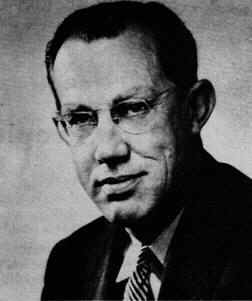
Clare W. Graves
Emergent Cyclical Levels of Existence Theory (ECLET)
Clare W. Graves (1914–1986) was an American psychologist and professor whose lifelong research led to the Emergent Cyclical Levels of Existence Theory (ECLET), a comprehensive biopsychosocial theory of adult development. Dissatisfied with existing personality and developmental theories, Graves spent decades empirically investigating how human beings develop increasingly complex ways of thinking, valuing, and living in response to changing life conditions. His work proposes a dynamic, emergent, and cyclical model of human existence, outlining successive levels of psychological and cultural functioning that manifest in individuals, organizations, and entire societies.
Key Concepts and Contributions:
Emergent Cyclical Double-Helix Model: Graves conceived of human development as a continuous, oscillating interaction between life conditions/problems (demands of the world) and coping mechanisms/neurological systems (the ways humans respond). As individuals and societies solve existing problems, new, more complex problems emerge, stimulating the development of new, more complex ways of thinking and being. This creates a “double-helix” of unfolding reality and consciousness.
Levels of Existence / Value Systems (vMEMES): Graves identified eight distinct “levels of existence” (which his followers later termed “vMEMES,” or value systems), each representing a unique way of organizing one’s existence, valuing, and perceiving the world. These levels emerge in response to specific challenges and are neither inherently “good” nor “bad,” but represent adaptive strategies. The levels alternate between “express-self” (individualistic) and “sacrifice-self” (collectivistic) modes. Examples include:
-
Beige (Survival): Focus on basic survival, automatic reflexes.
-
Purple (Tribalistic): Safety in kin groups, magical thinking, traditions.
-
Red (Egocentric/Exploitative): Power, impulsive action, immediate gratification.
-
Blue (Authoritarian/Order): Stability, purpose, absolute truth, sacrifice for a cause.
-
Orange (Achievist/Strategic): Success, progress, materialism, self-reliance.
-
Green (Communitarian/Relativistic): Harmony, consensus, equality, sensitivity.
-
Yellow (Systemic/Integral): Understanding the whole system, flexibility, knowledge, competence over power.
-
Turquoise (Holistic/Global): Experiential, interconnectedness, global harmony, spiritual perspective.
Open-Ended Development: A key tenet of Graves’s theory is that development is open-ended, meaning there is no final, ultimate level of existence. As humanity faces new existential challenges, new levels of consciousness will potentially emerge.
Psychological Discomfort and Transition: Graves noted that individuals often experience psychological discomfort or “dissonance” when their current coping mechanisms are insufficient for the demands of their life conditions. This discomfort acts as a catalyst for developmental transition to a new level.
Significance for Cultural/Historical Evolution of Consciousness:
Graves’s work holds immense significance for understanding the cultural/historical evolution of consciousness for several reasons:
-
Empirical Basis for Macro-Development: He provided an empirically grounded psychological model for understanding how fundamental value systems and ways of thinking have evolved in human history and continue to do so in individuals and societies.
-
Explaining Societal Shifts: His theory offers a powerful lens for interpreting major historical shifts, cultural clashes, and the dominant worldviews of different eras as expressions of these underlying levels of existence.
-
Integrating Individual and Collective: Graves’s model seamlessly links individual psychological development to the broader evolution of collective consciousness and cultural forms, showing how one influences the other.
-
Nuanced View of Progress: By presenting levels as adaptive responses to conditions rather than purely “better” or “worse,” Graves provides a more nuanced view of progress, emphasizing the strengths and challenges inherent in each stage.
In summary, Clare W. Graves’s Emergent Cyclical Levels of Existence Theory (ECLET) provides a foundational biopsychosocial framework for understanding the cultural and historical evolution of consciousness. By proposing successive levels of existence (vMEMES) that emerge in response to changing life conditions, he illuminated a dynamic and open-ended process of human development, offering profound insights into the evolving ways individuals and societies think, value, and organize their realities.