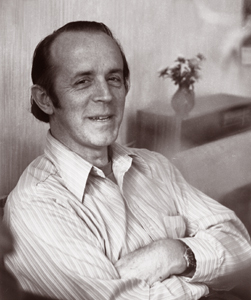
Klaus F. Riegel
Dialectical Operations and the Dynamics of Thought
Klaus F. Riegel (1925–1977) was a German-American psychologist and a prominent figure in dialectical psychology. Riegel argued passionately that traditional developmental theories, particularly those influenced by Piaget, often presented an overly linear and static view of cognitive growth. He proposed that adult cognitive development progresses beyond formal operational thought to a more advanced stage characterized by dialectical operations, where individuals actively perceive, embrace, and integrate contradictions, rather than seeking to resolve them through purely logical means. His work emphasized the dynamic, ever-changing nature of thought and its deep connection to social and historical contexts.
Key Concepts and Contributions:
Dialectical Operations: Riegel proposed that dialectical thinking constitutes a “fifth stage” of cognitive development, moving beyond Piaget’s formal operations. While formal operations aim to achieve logical consistency and resolve contradictions, dialectical operations involve the ability to:
-
Appreciate Contradiction: Recognizing that opposing ideas, forces, or perspectives are inherent parts of reality and necessary for understanding complex phenomena. Contradictions are seen as drivers of change, not errors to be eliminated.
-
Understand Dynamic Change: Perceiving reality as a constant process of change, transformation, and evolution, rather than a collection of static facts or fixed truths.
-
Embrace Relativism and Context: Understanding that knowledge and truth are often relative to specific contexts, perspectives, and historical moments, moving away from absolute certainty.
-
Integrate Opposites: The capacity to synthesize contradictory ideas or forces into a higher, more complex understanding, creating new knowledge or perspectives.
Riegel argued that this form of thinking is essential for grappling with the complexities and ambiguities of adult life, where many problems lack simple, linear solutions.
Dynamic Interactionism: Riegel emphasized the continuous, reciprocal interaction between the individual and their environment (including social, historical, and cultural forces). He believed that development arises from the constant interplay and resolution (or integration) of contradictions that emerge from these interactions. This “dynamic interactionism” means that adult thought is always evolving in response to changing conditions and the inherent tensions within reality.
Challenge to Static Stage Theories: Riegel was a vocal critic of theories that presented development as a smooth, linear progression through fixed stages. He argued that development is often characterized by crises, conflicts, and leaps, driven by the contradictions inherent in human experience. This makes adult development a more turbulent yet potentially richer process.
Significance for Adult Development:
Riegel’s work holds immense significance for understanding adult development, particularly in cognitive processes, for several reasons:
-
Pioneering Post-Formal Thought: He was among the earliest and most influential theorists to systematically articulate a distinct stage of cognitive development beyond adolescence, providing a strong theoretical basis for the concept of “post-formal thought” in adulthood.
-
Navigating Life’s Contradictions: Riegel’s emphasis on dialectical operations directly addresses how adults cope with the inherent contradictions, ambiguities, and dilemmas of real-world life, such as conflicting roles (e.g., parent vs. professional), moral ambiguities, and the paradoxes of relationships.
-
Explaining Adult Growth in Complexity: His theory helps to explain how adults develop the capacity for more sophisticated and nuanced thinking, allowing them to engage with complex social issues, philosophical questions, and personal challenges that require integrating multiple, often opposing, viewpoints.
-
Emphasis on Lifelong Learning: By viewing development as a continuous process driven by contradiction and change, Riegel underscored that adults are constantly challenged to revise their understanding of reality, making lifelong learning an intrinsic aspect of their cognitive growth.
In summary, Klaus F. Riegel’s pioneering work on dialectical operations established him as a foundational figure in post-formal thought for adult development. He passionately argued that mature adult cognition involves the capacity to perceive, embrace, and integrate contradictions and to understand reality as a dynamic process of change, providing a crucial framework for navigating the inherent complexities of adult life.