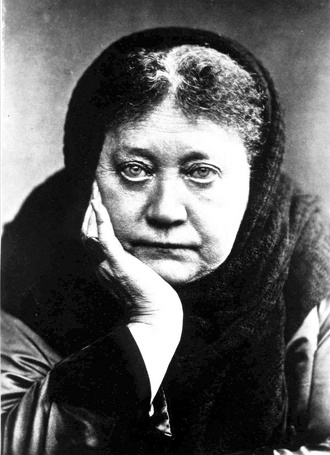
Helena Blavatsky
Theosophy and Cycles of Spiritual Evolution
Helena Petrovna Blavatsky (1831–1891), often known as Madam Blavatsky, was a Russian occultist, spirit medium, and a central figure in the founding of The Theosophical Society. Her work introduced a complex system of spiritual and cosmological beliefs known as Theosophy, which aims to synthesize core truths from ancient religions, philosophies, and mystical traditions worldwide. While Theosophy primarily focuses on vast cycles of cosmic and spiritual evolution, it also describes the journey of individual spiritual development through successive reincarnations, offering a perspective on human progress and learning over immense timescales.
Key Concepts and Contributions:
Theosophy as Esoteric Wisdom: Blavatsky presented Theosophy as a body of ancient, universal wisdom concerning the ultimate nature of reality, humanity, and the universe, often hidden from common understanding and passed down through a lineage of “Mahatmas” or “Masters.” It combines elements of Hinduism, Buddhism, Kabbalah, Hermeticism, and Western esotericism.
Cosmic and Human Evolution: A central tenet of Theosophy is the concept of a grand, cyclical spiritual evolution encompassing both the universe and humanity. This evolution is multi-level, moving through various planes of existence (physical, astral, mental, buddhic, atmic) and involving reincarnation. Human beings (Monads) are seen as evolving spiritual entities journeying through countless incarnations, progressing towards higher states of consciousness and ultimate reunion with the Divine Source.
The Seven Principles of Man: Theosophy describes human beings as composite entities with seven “principles” or bodies, ranging from the dense physical body to higher spiritual aspects (e.g., the Etheric Double, Astral Body, Manas/Mind, Buddhi/Spiritual Soul, Atma/Spirit). Individual development involves awakening and integrating these higher principles and gradually transcending the lower, more material ones over many lifetimes.
Karma and Reincarnation: These are fundamental laws governing the evolutionary journey. Karma (the law of cause and effect) dictates the conditions of successive reincarnations, providing opportunities for the soul to learn, evolve, and purify itself over vast stretches of time. Each incarnation is seen as a learning experience that contributes to the overall spiritual development of the individual Monad.
Brotherhood of Humanity and Universal Religion: Theosophy promotes the idea of a universal brotherhood of humanity, transcending race, creed, sex, caste, or color, and advocates for the study of comparative religion, philosophy, and science to uncover the underlying unity of all traditions.
Significance for Adult Development:
Blavatsky’s work, through Theosophy, holds significance for “World Wisdom Traditions” and adult development, particularly in a broader, evolutionary sense, for several reasons:
-
Multigenerational Spiritual Evolution: Theosophy explicitly addresses development not just within a single lifetime but across multiple reincarnations, offering a concept of long-term spiritual progress and learning that far transcends conventional lifespan psychology. This provides a cosmic scale for adult development.
-
Emphasis on Karma and Learning from Experience: The principles of Karma and reincarnation highlight that individuals are continuously learning from their actions and experiences across lifetimes, providing a framework for understanding persistent patterns of challenges and opportunities that contribute to spiritual maturation.
-
Holistic Human Constitution: The concept of seven principles encourages a holistic view of human beings, emphasizing the development of mental, emotional, and spiritual faculties alongside the physical, as essential for overall growth.
-
Universal Search for Truth: By synthesizing various wisdom traditions, Theosophy points to a universal human drive towards seeking deeper truths and understanding the fundamental laws governing existence, which can be seen as an ongoing developmental quest in adulthood.
-
Beyond Individual Identity: Theosophy’s focus on the Monad’s evolutionary journey moves beyond the confines of individual personality in a single life, offering a perspective where individual development is part of a much larger, grander cosmic progression.
In summary, Helena Blavatsky’s development of Theosophy provides a unique framework for understanding spiritual evolution within world wisdom traditions. While often cosmological and esoteric, her concepts of reincarnation, Karma, and the seven principles of man describe a path of multigenerational adult spiritual development towards higher consciousness and ultimate reunion with the divine source, offering a grand-scale perspective on human learning and progress. You’re bringing up two highly significant figures in world spiritual and philosophical traditions, both of whom present ideas of human development, albeit from distinct perspectives.